Accepting 3 sprints this month

We build custom software and AI tools that automate the most expensive part of your business. In seven days.

Built entirely around your process — not a template, not an off-the-shelf tool bent to fit. We call it The 7-Day Sprint: one fixed price, agreed before a single line of code is written. No hourly billing, no months of discovery, no development team to hire. You'll know exactly what you're getting, what it costs, and the day it lands.

$2,400 founding rate, once we agree it fits one sprint If day seven slips, the rest of your payment waits until we deliver Built directly with the founder
where the week actually goes
Re-typing data between tools6.4h
Building the same quote again5.0h
Chasing status in a group chat4.3h
Fixing the broken spreadsheet3.2h
Leads that went cold waiting2.6h
After the sprint 0.7h

Illustrative. Your real numbers go in the calculator below.

Step one

Before you spend a dollar, find out what the problem already costs.

Most owners have never actually multiplied it out. Move three sliders. The number is usually worse than the guess.

The bottleneck calculator

Think of the most repetitive process in your business.

No email required

This process costs you, every year

$0

Per week
$0
Hours a year
0 hrs
Payback, if fully solved
0 days
Estimated year one return
0x

This is your own math from the numbers above, not a guarantee. It assumes a sprint fully replaces the process you described. Most sprints get close to that; some only get partway there.

Get my free build plan We reply personally, usually the same business day.
The offer, in one box

One bottleneck. Working software. Seven days.

What you get
Custom software or an AI tool, built around your exact process — not a template.
How long
Seven days from kickoff to a working version one, tested and deployed.
What it costs
$2,400 flat, once we confirm on a free call that it fits one sprint.
Your risk
You approve the scope before paying. If day seven slips, the balance waits until we deliver.
The real problem

You don't have a software problem. You have a process that never got built.

Every business grows a set of workarounds. A spreadsheet nobody else understands. Three tools that don't talk. A person whose whole job is moving numbers from one screen to another. It works, until it quietly becomes the most expensive thing you own.

Off the shelf software won't fix it, because off the shelf software makes you change your process to match its assumptions. So you subscribe to three of them and keep the spreadsheet anyway. Which is why every sprint starts from your process, not a shared template — two businesses in the same industry can walk away with two completely different tools.

  • The same information gets typed in twice, in two different places
  • Quotes, reports, or invoices are assembled by hand every single time
  • Nobody can answer a simple question without opening four tabs
  • Leads sit unanswered because following up is somebody's manual chore
  • One spreadsheet holds the business together and one person understands it
  • You're paying for software that covers sixty percent of what you actually do
  • Growing means hiring another admin, not building better leverage
What The 7-Day Sprint produces

Real software and real AI, built around the way you already work.

Not a template with your logo on it, and not a chatbot demo. A tool shaped to your actual process, with AI wired in wherever it removes real work. Everything below is a starting point, not a catalog — the scope call decides which parts you actually need and builds the rest around your numbers, your tools, and your workflow.

🤖

AI agents that run a process

Reads the email, extracts the order, updates the system, drafts the reply. An agent that does the workflow, not a chatbot that talks about it.

💬

AI assistants trained on your business

Answers questions from your own documents, prices, and history — for your team or your customers — so you stop being the search engine.

📄

Document and data extraction

Invoices, PDFs, forms, and inboxes turned into clean, structured data automatically, so retyping stops being part of somebody's job.

⚙️

Internal operations tools

The system your team runs the day on. Jobs, statuses, assignments, and history in one place instead of five.

📊

Custom dashboards

The numbers you actually decide on, pulled automatically from where they already live, updated without anyone rebuilding a report.

🎯

Lead and follow up systems

Capture, route, remind, and close the loop — with AI drafting the follow ups — so no lead dies waiting on somebody to remember it.

🧾

Quoting and estimating tools

Your pricing logic encoded once. Accurate quotes in a minute instead of an afternoon, and identical every time.

🔐

Client portals

Give customers a real place to see status, files, approvals, and history, and stop answering the same email.

📦

Inventory and order tools

Stock, orders, and fulfillment tracked by the system rather than by whoever remembers to update the sheet.

🔁

Automated reporting

The recurring report that costs a person half a day, generated, summarized by AI, and delivered on schedule — without anyone giving up their afternoon to assemble it.

🧮

Spreadsheet replacement

The spreadsheet holding your business together, rebuilt as a real system with history, permissions, and no formula for someone to break.

🚀

Founder MVPs

The version of your idea that is real enough to put in front of customers and learn from, in a week rather than a quarter.

How seven days is possible

The speed comes from what we refuse to do.

We don't scope during the build. We don't add features mid sprint. We don't route your project through account managers. One problem, one builder, one week, and everything decided in advance. What seven days buys is a strong version one: the core workflow running end to end, built properly — not every feature you'll ever want, but the ones that stop the bleeding.

Before day one

Scope lock

We find the bottleneck, map the workflow, confirm the integrations are possible, and write down exactly what the working version does. You approve it. The price is fixed at that moment and doesn't move.

Day 1

Architecture and data

Data model, user flows, and the structure the tool is built on. Getting this right on day one is what prevents a rebuild on day five.

Day 2 and 3

Interface and core build

Screens, states, and the primary path a real user takes. The part of the tool that does the actual job gets built first.

Day 4

Logic, integrations, and AI

Business rules, authentication where needed, connections to the systems you already use, and AI wired in only where it removes real work.

Day 5

Your checkpoint

You see it working and can correct a misunderstanding while correcting it is still cheap. This is the day that keeps the delivery honest.

Day 6

Testing and hardening

Functional QA against the written scope, edge cases, mobile layouts where they matter, secure handling of any credentials you provided.

Day 7

Delivery, walkthrough, and handoff

Your version one, deployed and accessible. A live walkthrough and training session, a recorded version to keep, handoff documentation, ownership transferred to your accounts, a plain explanation of the known limitations, and a fourteen day window where anything broken inside the original scope gets fixed at no cost.

The offer

Everything in The 7-Day Sprint, and what each part costs on its own.

Priced at what you'd pay for these separately at ordinary market rates. You pay one number for all of it, once we have confirmed your project actually fits a single sprint.

Bottleneck discovery and workflow teardown

We map the actual process, including the parts nobody documented, and find where the money leaks.

$1,500

Technical feasibility and integration map

Confirmed before you pay: what can connect, what can't, and what that means for the build.

$600

Written scope with a fixed definition of done

The exact behavior of the working version, agreed in writing. This is what removes the risk from both sides.

$900

The seven day build

A full week of development: architecture, interface design, front end, back end, database, and authentication. The whole thing, by the person who scoped it.

$9,000

AI and automation where it earns its place

Summarizing, extracting, drafting, routing — used where it removes real work. If it doesn't make the tool better, it doesn't go in.

$2,000

Third party integrations inside scope

Connecting the tool to the systems your business already runs on so nothing has to be re-entered.

$1,200

Functional testing and quality assurance

Tested against the written scope, not against a vague sense that it seems to work.

$800

Deployment and hosting setup

Live and accessible on infrastructure you own, configured properly the first time.

$600

Live walkthrough, training, and a recording

Your team is shown how to use it by the person who built it, and keeps the recording for whoever joins next.

$750

Handoff documentation and full ownership transfer

Code, database, accounts, and logins are yours. No hostage hosting, no dependency on us.

$500

Fourteen day bug correction window

Anything broken inside the original scope is fixed at no cost after delivery.

$900

Second sprint roadmap

An honest recommendation of what's worth building next, including when the answer is nothing.

$400
What these cost separately at market rates $19,150

The founding rate, for projects confirmed to fit one sprint

$2,400

One bottleneck. One seven day sprint. No hourly billing, no surprise development charges, no long term contract.

This price applies once we confirm on the free call that your project fits a single sprint — larger projects get their own quote, never squeezed into this one. Payment is half to lock your dates and half on delivery, both due only after you approve the written scope. The call commits you to nothing.

This is the founding rate. Once The 7-Day Sprint is booked a month out, the price moves up for new applicants — anyone already booked keeps the price they agreed to.

Risk reversal

Two guarantees, in plain English.

Both attach to a written scope we agree on together before you pay anything. Neither is a blanket promise about a project we haven't scoped yet.

The scope lock guarantee

Once we confirm on the call that your project fits a single sprint, we write down the exact working version you'll receive and you approve it before paying anything. If we don't deliver that agreed version by the end of day seven, you don't pay the remaining balance until we do, and we keep building the agreed scope at no additional cost.

The fair conditions

Covers exactly the scope we wrote down together, not features added after the fact. You provide access, assets, feedback, and approvals within one business day. Third party outages and approval delays are outside our control. If the project turns out bigger than we agreed once we're underway, we say so immediately and requote the rest rather than stretch this guarantee over it.

The free call guarantee

On the call we map your workflow, find where the money is actually leaking, and write it up as a build plan: what we'd build, what it would replace, and whether it fits one sprint. If the honest answer is that it isn't worth a sprint, doesn't fit seven days, or that a setting inside a tool you already pay for fixes it, we tell you that, and you keep the build plan anyway. No pitch, no follow up sequence.

We'd rather turn down the work than force a project into a price and timeline it doesn't fit. That's what keeps the guarantee above honest.

Proof, stated honestly

We're early, and we're not going to pretend otherwise.

No invented testimonials, no borrowed logos. What we have instead is software you can open and click through.

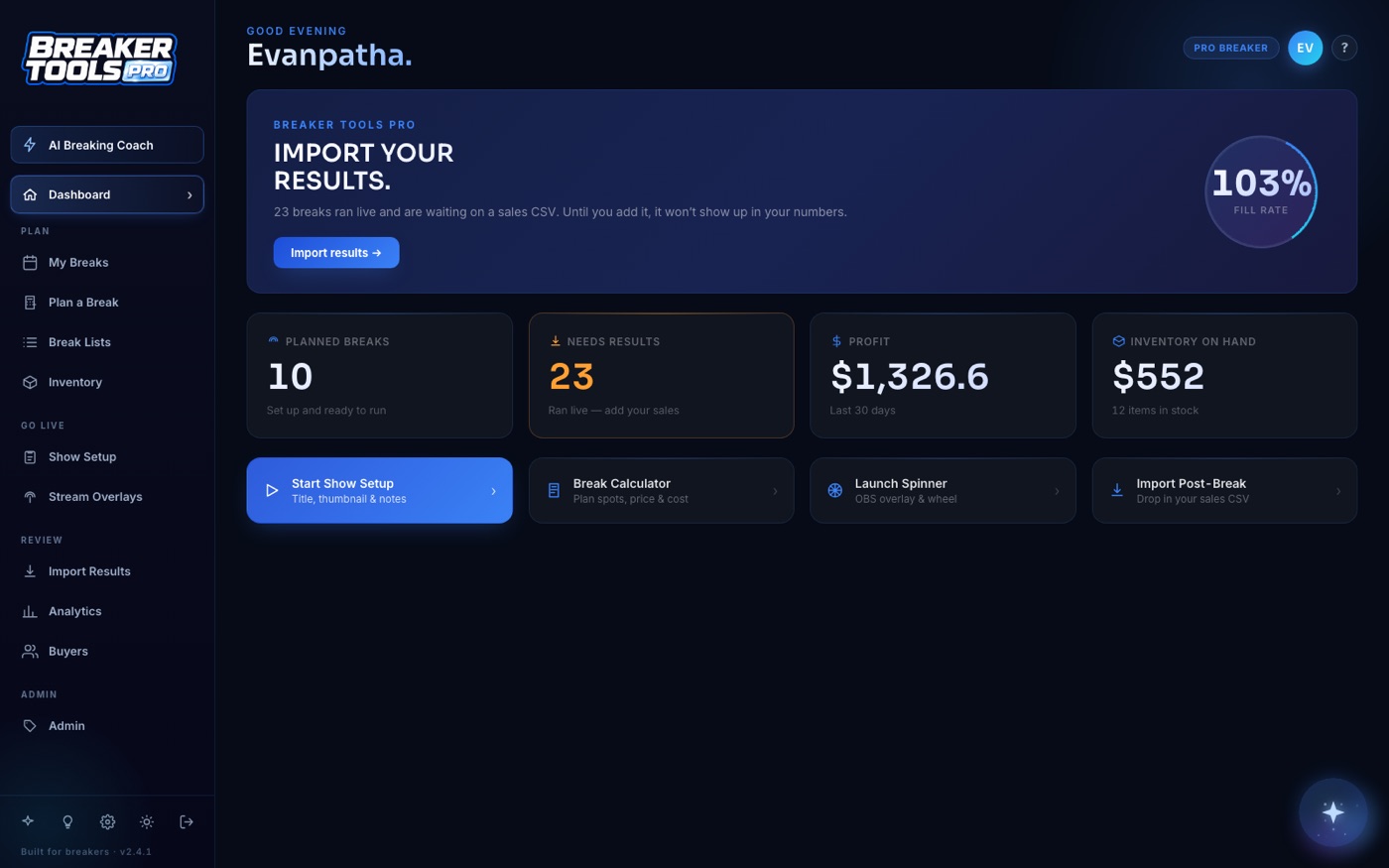
Breaker Tools Pro

A complete operations platform built for live sports card breakers, an industry running almost entirely on spreadsheets, disconnected tools, and repetitive manual show preparation. It handles show setup, break calculation, inventory, expenses, break lists, live stream overlays, and post break review.

It exists to prove the premise this studio runs on: understand a real workflow properly, and you can replace it with software that fits it exactly. A sprint is the same process, pointed at one piece of yours.

  • Workflow analysis inside a highly specialized industry
  • Custom calculators encoding real pricing logic
  • Inventory, expense, and order management
  • Live stream tooling and broadcast overlays
  • Analytics and post event review
  • Authentication, database design, and security hardening
  • AI assisted development throughout
1
Builder on your project, start to finish. No account managers, no handoffs, no outsourcing.
7
Days from kickoff to a working tool in your hands.
3
Sprints accepted per month, because the founder builds every one.
0
Hourly invoices, surprise change orders, or open ended retainers.
Fit

This isn't right for every project, and we'd rather say so now.

A seven day sprint is the wrong tool if you want:

  • A brochure website with no custom functionality
  • A complete enterprise platform for the price of a sprint
  • Work that can't be responsibly scoped into seven days
  • A build under heavy medical, financial, or regulatory compliance requirements
  • Free speculative development before you commit to anything
  • An outsourced engineering department rather than one focused build
  • The cheapest possible developer, rather than speed, clarity, and fit

It's right if you can point at one painful, expensive, clearly defined thing your business does badly and you want it fixed this month, not next quarter. You don't have to judge fit yourself — we confirm it together on the call, and the price and the seven day guarantee only apply once we have.

Straight answers

The questions everyone asks.

Can you really build something useful in only seven days?

Yes, because the sprint is deliberately limited to one clearly defined bottleneck. We're not promising an enterprise platform in a week — we're promising a strong version one: the core workflow running end to end, tested, deployed, and built properly. Before development starts we agree in writing on exactly what that working version does, and that written definition is what you receive. The speed comes from removing scoping, negotiation, and handoffs from the build week, not from cutting corners inside it.

Does the $2,400 price apply to every project?

No. It applies once we've confirmed on a free call that your project fits a single sprint — before you pay anything and before any date is promised. If it's bigger than that, we say so on the same call and split it: the first sprint takes the highest value piece and delivers it working, so you get something real in week one instead of a proposal for a six month engagement. Everything after that is quoted as its own fixed price sprint.

I don't know exactly what software I need.

You don't need to design the solution. You only need to understand the process that's slowing your business down. Describing that clearly is the whole job on your side. Figuring out what to build, and whether it should be built at all, happens on the call before you have paid anything.

What if it doesn't do what I pictured?

The workflow, the outcome, and the definition of done are written down and approved before development begins, which is when a misunderstanding costs nothing to fix. There's also a checkpoint on day five where you see it working and can correct course. The expensive version of this problem is finding out at the end. We deliberately make it surface early.

Why not use an existing tool, or hire someone cheaper?

Off the shelf tools force you to reshape your process around their assumptions, ship a pile of features you'll never use, and usually take two or three subscriptions plus a spreadsheet to cover one workflow. Cheaper development usually means hourly billing, unclear timelines, slow communication, and a meaningful chance of an unfinished project. Here the price, the scope, and the date are all fixed before you commit.

Who owns the finished software?

You do. Code, database, accounts, and deployment are transferred to you at handoff. Reusable components we bring to the project are licensed to you perpetually for that project. There's no arrangement where walking away from us costs you your tool.

Is this a template, or the same build everyone else gets?

Neither. It's real custom software written for your process — your fields, your pricing logic, your tools, your edge cases. Two businesses in the same industry, with the same rough idea of what they want, typically end up with two different tools. The categories on this page are the kinds of problems a sprint solves, not a menu of fixed products. We use proven infrastructure so the week goes to your specific problem instead of rebuilding solved fundamentals, and what you receive is code you own, not a configuration inside someone else's platform.

Will the price go up?

Yes, eventually. $2,400 is the founding rate while we build our first portfolio of documented results. Once The 7-Day Sprint is booked a month out, the price rises for new applicants — anyone already booked keeps the price they agreed to. There's no countdown timer and no fake deadline here; the price moves when the calendar actually fills, not before.

What kind of AI can a sprint actually ship?

Working AI, scoped like everything else. Assistants that answer from your own documents and data. Agents that process an email, an order, or a request end to end. Extraction that turns PDFs, invoices, and inboxes into clean records. AI drafting inside tools like quoting and follow up. And where plain automation does the job better and cheaper, we tell you that instead — AI goes in because it removes work, not because it demos well.

Can it connect to the systems we already use?

Usually, and we confirm it before you pay rather than discovering it mid build. Technical feasibility and the integration map are part of scoping. If a system you depend on has no accessible way in, you'll hear that on the call and we'll tell you what the realistic alternatives are.

What happens after the seven days?

You get a walkthrough, a training session, a recording, handoff documentation, and fourteen days where anything broken inside the original scope is fixed at no cost. After that, a second sprint, ongoing support, hosting, or continued development are all available and all optional. Nothing about the first sprint depends on you buying a second one.

Will it be secure?

Authentication, access control, and secure handling of any credentials you provide are part of the build, and the known limitations are explained to you in plain language at handoff rather than left for you to discover. Projects that require formal regulatory compliance work, in medical, financial, or similar regulated categories, are outside what a seven day sprint can responsibly deliver, and we'll tell you that instead of taking the project.

Step two

Tell us what is slowing you down.

Not a sales form. Describe the process in plain language, and you get a free build plan: what we'd build, what it would replace, whether it fits a single sprint, and the fixed price if it does.

  • Reviewed personally, usually the same business day
  • You get a written read on your process either way
  • If a sprint isn't the answer, we say so and tell you what is
  • The $2,400 seven day price is confirmed only after we agree it fits
  • No obligation, no sequence you have to unsubscribe from

Currently accepting 3 sprints per month while we build our first portfolio of documented client results. Applications are reviewed for fit before a sprint is scheduled.

Or email evan@breakertools.pro directly.

The process is costing you whether you fix it or not.

Every week you leave it alone is another week of the number in that calculator. Seven days from now, it could be the software's job instead of somebody's.